 Komondor Breed Rescue



Breedinfo
Contents of the article
1. How to choose a puppy? 2. Habitat 3. General care 4. Training and socialization 5. Feeding 6. Fur care 7. Vaccinations 8. Parasite preventionHow to Choose a Puppy?
The first and most important factor is to choose a puppy with a stable nervous system.
Whether the puppy comes from the best litter of the world's best breeder or from the guard dog at Uncle Joe's farm, never take home a cowardly, unstable puppy.
Why?
Because it will only cause trouble. As cute as it may be as a puppy, it will never do what we expect from it when it grows up, it will never be as reliable as we would expect from such a big dog, in short, we will be disappointed. Who wants to live for 10-15 years with a dog that is just a burden? It is also worth seeing that bad dogs often end up chained at the back of the garden, in pounds, or in the dump. But even before that, we will be faced with a situation that will only bring grief, suffering, and a lot of unnecessary and avoidable waste of time and money.
It's also a basic fact to know that a litter is never uniform. There are better and worse puppies, prettier and uglier ones. There are more dominant ones, and there are more submissive ones, there are those who require more human company and those who are more distrustful. Try to select the breeder and the puppy from the litter that best fits our lifestyle. So first think through what we need the dog for. Just for guarding the property, or one with which we can also go hiking. One who, in addition to loving his family, also protects the family property. Or just need a big white garden ornament.
As a first step, let's look at where the puppy comes from. Forget the stereotype that a "farm" Komondor can only be good. There are good Komondors on farms and some that are worth less than what they eat. But the same is true for Komondors bought from breeders. Many show titles are no guarantee of quality.
Look at the parents, possibly the puppies from the previous litter. See where they are kept, what they are fed. Conscious buying can greatly improve the future situation of the puppies and the parent pair. Because if we don't buy a puppy from a bad place, then no more will be born there.
As a second step, make sure what characteristics the given parent pair possesses. If we have enough courage, we can check their instincts on the spot. But if we are prepared for a calmer purchase, it is advisable to request some video material of the dogs. In today's era of mobile phones, practically no one can say that they can't provide this.
As a third step, still staying with the parents, make sure of the health status of the parents. The Komondor, like many large breeds, has its diseases resulting from its size. Since a dysplasia surgery can cost serious tens or hundreds of thousands, always make sure that the parents are dysplasia free. Eyelid inversion can also be considered a breed disease, and since it is hereditary, avoid puppies of individuals with weepy, inflamed, or operated eyes.
Take enough time to select the puppies. Don't take the first puppy that comes to us home. Try them out in different situations. Pick them up, cause unexpected and loud noises, put them in front of sudden problems and watch their reactions. Leave the puppy who runs away screaming and/or tucks its tail at a sudden noise. The one who, when put in a box, panics and looks for a way out after some looking around is best avoided. Such will never make a good dog. Watch how the puppies relate to each other. We will have more trouble later with puppies that are too violent or too timid. Look for calm, not too lively, not too aggressive individuals, so the ideal middle ground.
By choosing the right puppy, we can save ourselves a lot of unnecessary expenses and inconvenience. In addition to the everyday inconveniences (because living with a bad dog comes with a lot of problems), we also save ourselves a lot of unnecessary costs. Training a bad dog takes more time and dog school can also be a significant cost. It should not be forgotten that we cannot change the basic characteristics with training. A bad, nerve-weak dog will always remain so, at most we can teach them to handle certain situations, but another unexpected situation can cause serious panic reactions in them, which we do not have to count on with a dog with a stable nervous system.
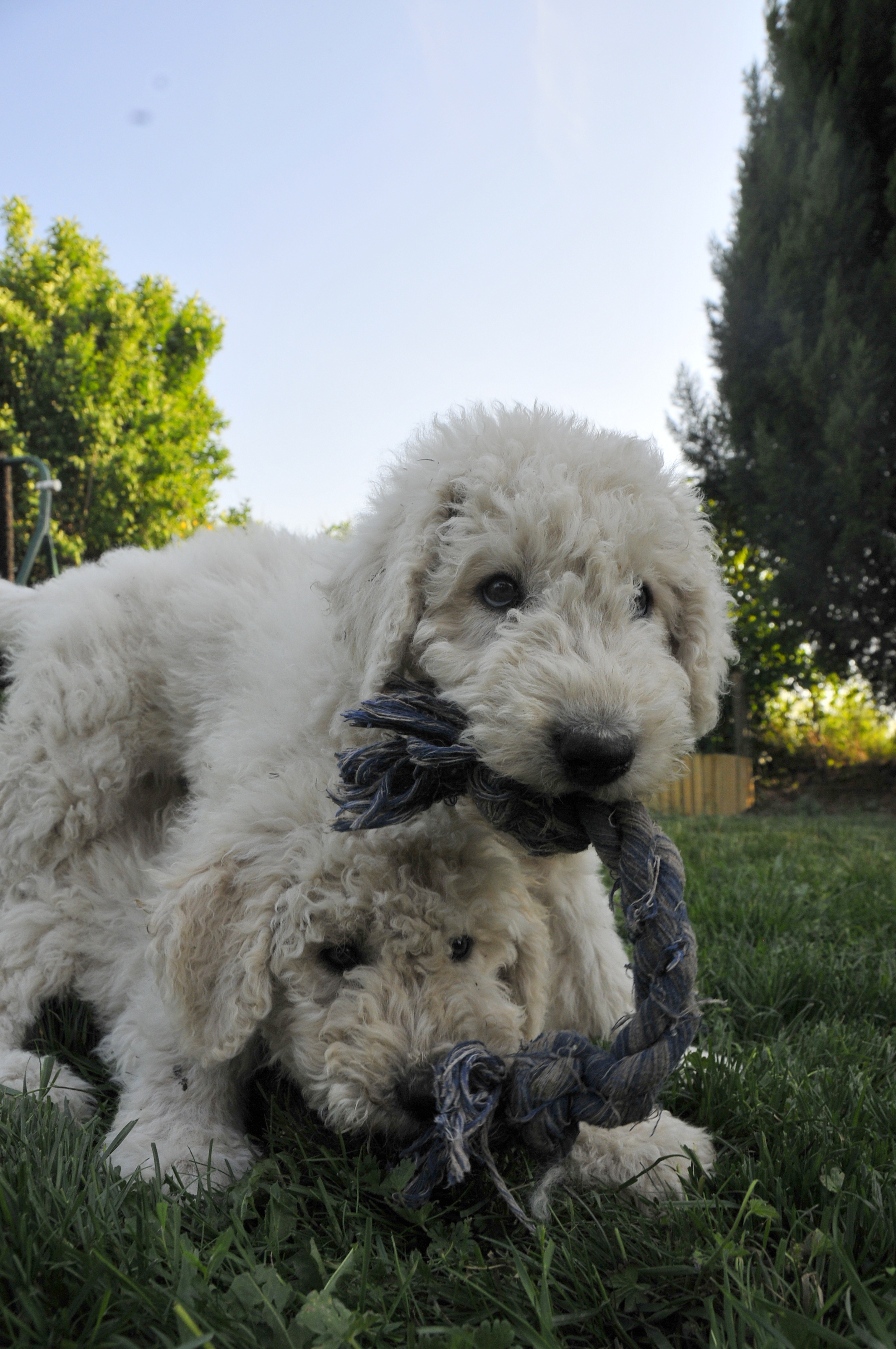
Habitat
Where should we keep the Komondor?
In the case of a show dog, the answer is simple, on concrete.
A dog with full fur gets very dirty. Therefore, those who go to shows usually keep their dogs in kennels or on completely concreted, paved yards.
The expectations are a bit different for family shepherd dogs.
They have much better opportunities, as they can live more freely, in a more dog-like way. They can go anywhere in the garden, in the yard. They can lie in the snow, mud, dust, or just near the owner.
For Komondor puppies, a very important consideration from a socialization point of view is to be as close to the family as possible, which of course, if it is going to be an indoor dog, is not a problem, but if we are going to keep it as an outdoor dog, then place its bed so that it is close to the door. Even for puppies (if kept outside), human proximity is important, but they soon settle into the space and choose the strategically most ideal place from where they can keep an eye on the entire area.
A Komondor rarely needs a dog house, but a dry nook where it can retreat from the rain is definitely needed. It's also important to think about the fact that although its coat heats in winter and cools in summer, in the summer heat there should be a relatively cool place (basement or garage) where it can retreat from the scorching sun and heat. Without it, it is likely to dig huge cooling pits in every important place in the garden. Although most Komondors do not like to bathe, they are grateful for a plastic sandbox, turned into a dog pool, where they like to cool off in the summer heat. With this solution, the water does not have to be constantly changed to cold.
What should definitely be avoided is constant chaining or kennel keeping. The Komondor finds it difficult to bear confinement, being tied up. It is a thinking, working creature that requires mental engagement. By constantly confining or tying it up, we deprive it of this, which can quickly make it grumpy and unpredictable. However, this is our fault, not the dog's.
Of course, it is not a problem if we occasionally restrict it in its free movement (e.g., during a family garden party), but a good-natured Komondor can handle this without any problems.
However, if we still choose kennel or chain keeping, then we should know that according to current animal protection laws, the minimum kennel size must be 20 square meters. The minimum length of the chain is 8 meters, but as of January 1, 2016, it is forbidden to keep dogs on chains.
A relatively small garden is not a problem if we can satisfy its need for exercise with daily walks.
In downtown areas, keeping it is a bit more troublesome, but not impossible. However, we should know that it is by no means an ideal living space for them.
As a proper family dog, it can be a suitable companion for daily walks, city tours, and even longer excursions, with proper socialization. However, one thing to keep in mind on such occasions is not to stop for long periods of time anywhere. Or if we do stop, then we should be prepared for the fact that a good Komondor will start to defend the area where we are standing within 10-15 minutes.
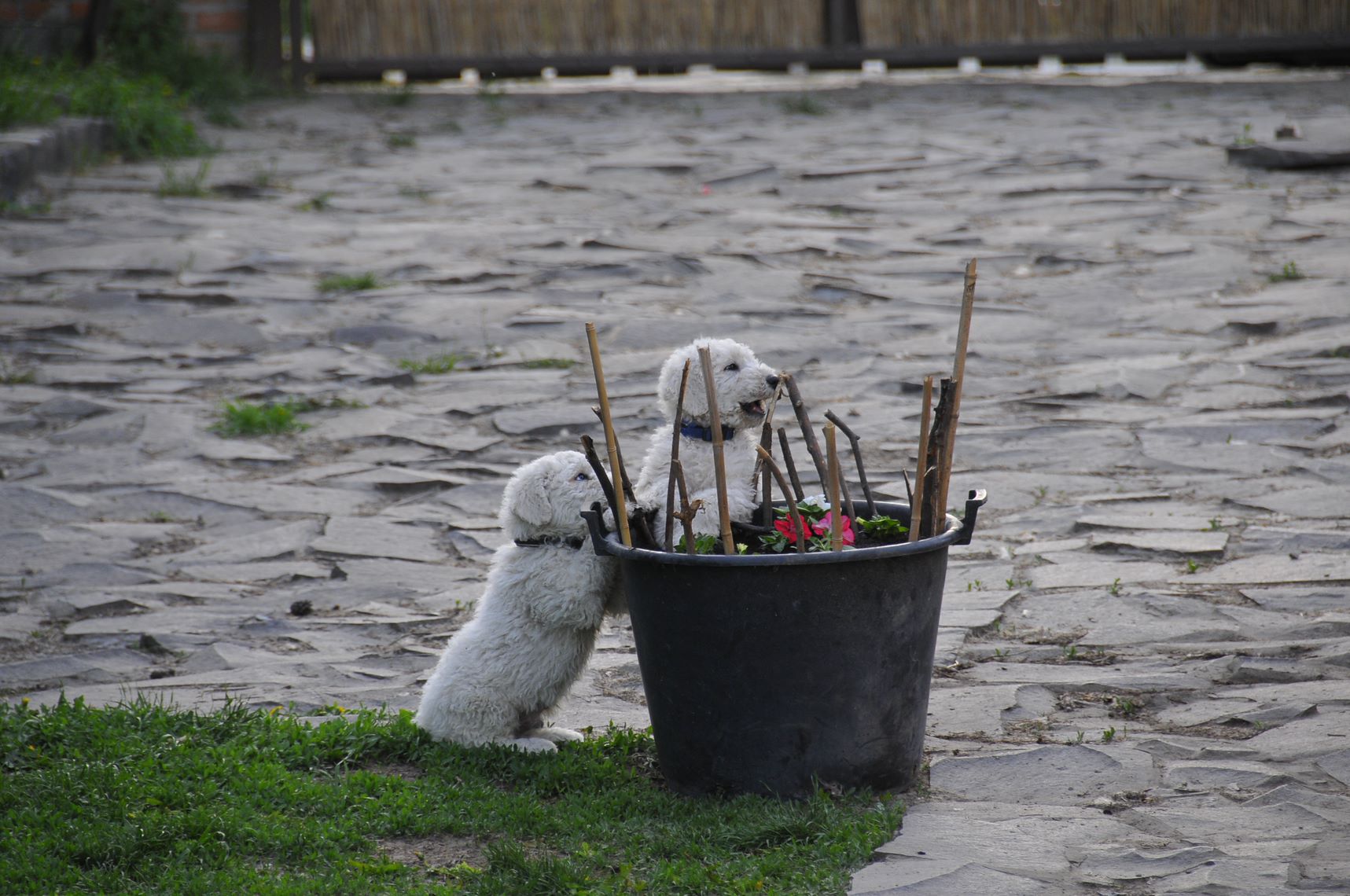
General care
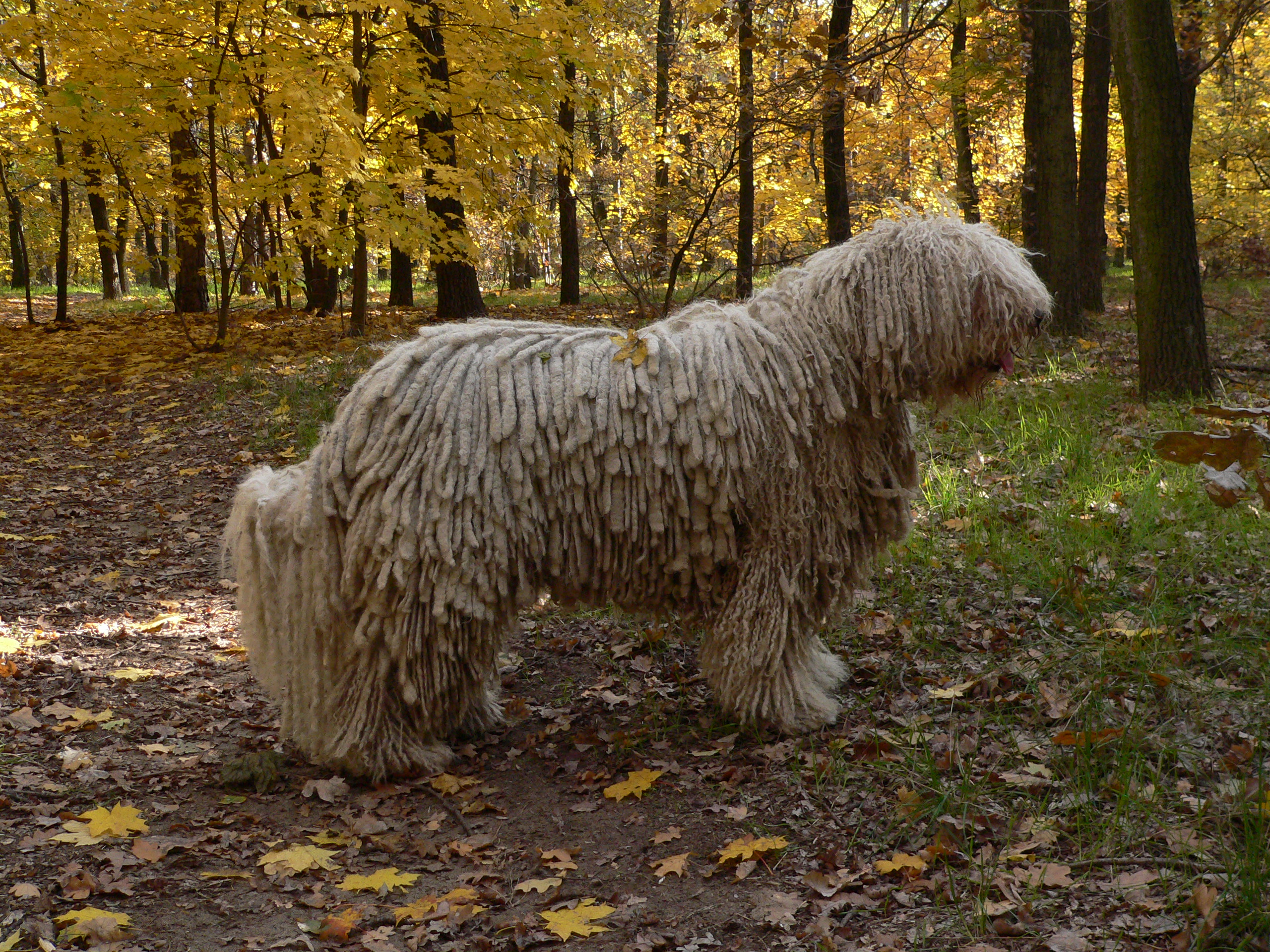
If we take care of it properly from puppyhood, petting and scratching it, then as soon as it reaches the age when its fur needs to be plucked, this becomes a pleasant game between the owner and the dog. The komondor's fur coat does not require any special care in the beginning. The corded texture begins to form around 10-12 months of age, which we need to help along with so-called plucking in critical areas. The komondor's hair naturally takes on a corded or tufted character, which the owner only needs to assist! Start the plucking at the end of the tuft and, with a firm but not too strong motion, pluck it to the right thickness all the way to the skin.
If the dog's fur has matted to the point where separating the cords is impossible (unfortunately, this is almost always the case with rescued dogs), then we indeed need to turn to a professional, who has the right tools and experience to choose the length of fur that can still be saved and remove the unsalvageable. As its fur is self-cleaning, the dirt from a walk will fall out of the dried fur. It is recommended to bathe them once a year with diluted shampoo water, but only do this during dry periods, as the thick fur of larger komondors may not dry out completely even in two days.
With larger-furred dogs, it is advisable to ensure that the fur around the dog's rear and anus is as clean as possible (e.g., after diarrhea, heat, or whelping), as lice can easily settle in, which can be a source of serious diseases in the future.
It's advisable to carefully trim the fur around the eyes to prevent inward-curling hairs from irritating the eyes. Hair also needs to be removed from the ears at intervals, which we can pinch with our fingers and pull out with a decisive motion, but it's advisable to get a hemostat, with which we can pluck the hairs deeply. The hairless ear can then be easily cleaned with ear cleaning solutions developed for this purpose. Simply drip the prescribed amount into the ear and massage at the base of the ear. This is necessary about every 3-4 weeks, but if we see that our dog is holding its head strangely or shaking it a lot, then start cleaning the ears immediately or visit our veterinarian!
A regularly active or exercised komondor does not require nail trimming, but with those that lie around lazily all day, overgrowth must also be watched for.
With proper feeding, tartar is not a problem, but with dogs living on kibble, tartar formation can be the source of many problems.
If we would like to keep more than one komondor, then prepare for hierarchical fights between male and male, female and female, and expect puppies between male and female.
Whether male or female, a komondor generally relates quite dominantly to other dogs. So, if we keep it with other breeds, it usually takes the top spot in the hierarchy. It will achieve this position one way or another, with gentle or not so gentle force.
A good komondor behaves friendly towards family members and pets, protecting and guarding them. This doesn't even need to be taught. They are very attentive and careful with our children, but expect that they might also protect them from other children during a rough play.
Anyone who wants to keep a komondor should first consider their possibilities and the needs of the breed to avoid their dog becoming scared or ending up in a shelter after a year. With an adopted adult dog, we have to live with an already formed character, which it is advisable to get to know as well as possible with multiple visits before adoption. If you want a puppy, turn to us, as the relationship between breed rescue and komondor breeders is excellent. We know the breeders' breeding guidelines, so we can recommend breeders with great accuracy to those who want a pet and to those who expect work from their future dog. This breed is one of the best for this reason, because besides that our children can play with it in complete safety, it also works perfectly as a personal bodyguard and house guard!
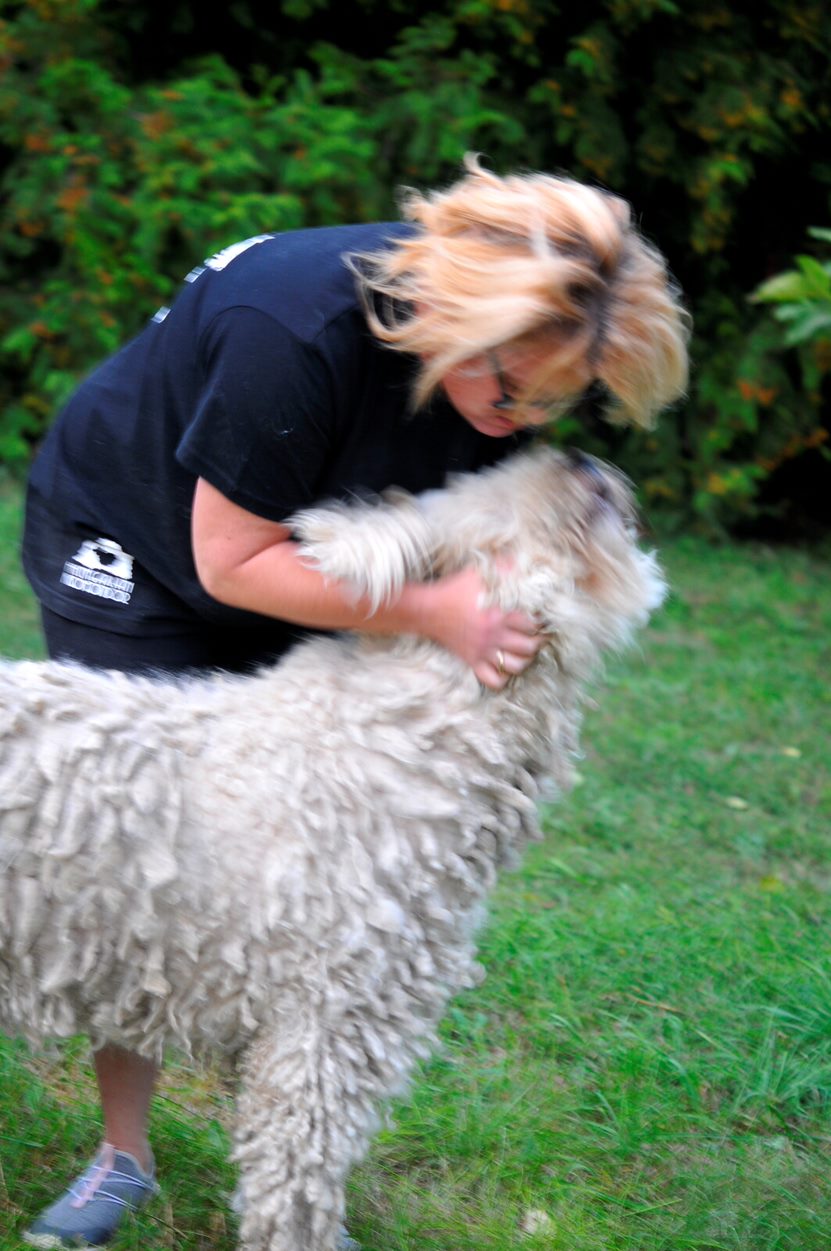
Training and socialization
Until the young komondor has received all necessary vaccinations, usually until 12-15 weeks of age, it is advisable not to take it into dog communities. Socialize the puppy at home, spend as much time with it as possible, let it get to know the family and other people associated with the family, and if there are any, the animals belonging to the house. If we have a komondor puppy and it is the only dog, it is advisable to give it something to chew on to keep itself busy, but be sure it will explore every corner of the garden and sooner or later try to damage it. After the vaccinations, it can be taken to outdoor areas, communities, and walks.
The younger it is exposed to noises, sounds, strange smells, and strangers, the more balanced it will be later on. The komondor is instinctively a distrustful breed, which of course does not mean that it will bite everyone who wants to enter our house, but rather that it will not allow just anyone to pet it and we should not expect such familiarity from it, especially if we expect it to protect and guard our family and property in the future. The komondor behaves in a very gentle manner with the family, its members, and especially with children, but let it be known that the human is the master at home.
A good komondor is a brave, decisive character dog, handle it in light of this so that it does not question its role in the pack. If any questions arise regarding training, it is better to turn to a professional (either a breeder or the komondor breed rescue). Note that most dog schools are not familiar with komondors, the shepherd dogs. Shepherd dogs require different training than other dog breeds. Do not let your dog be trained through 'scampishness'. Such training is based on the dog's prey instinct, which should not be present in a good shepherd dog. Thus, this type of training only harms the dog. Similarly, avoid places where they want to teach herding to our komondors. Herding is a behavior sequence based on prey instinct, in which a good komondor cannot excel.
Due to its attachment to the owner and intelligence, it learns easily, but do not forget that a 20-25 kg dog can be more easily encouraged to learn anything (e.g., traveling, getting into a car, etc.). The owner may decide not to walk the komondor (for whatever reason or misconception), but it is important for every dog to meet other dogs, encounter new and exciting smells, and interact with people. In my opinion, a daily 1-2 walks are recommended even for us.
Kennel keeping has its advantages and disadvantages. The advantage is that the lazy owner does not have to spend time training the dog, but just locks it away if they encounter a situation they cannot handle. This does not make a dog a better guard dog by keeping it away from contact with strangers, as many practical examples show. A good komondor behaves neutrally, or even friendly, in the presence of its owner towards strangers. In the absence of the owner, however, it bravely guards the family's property from intruders. In this case, an intruder may even mean someone who is not a close family member, not in daily contact with the dog. So, do not expect, for example, that a tractor driver who has been working for the family for years would be let into our farm by the dog in the absence of the owner. A good komondor does not do this.
For this to work well, practice should begin as early as possible with the puppy. The komondor excellently senses those who we like and those we do not, and for the latter's protection, start the following ritual as soon as possible; when the doorbell rings or there is a knock, most dogs immediately (or even before the knocking!) run to the door. Stand in front of them and with a hand gesture reinforced send them 3-4 steps away and do not open the door until they calm down.
If they approach the door against our instructions, step in front of them decisively and repeat the instruction. Only open the door after they have calmed down. Of course, we must inform every newcomer that our dog or dogs do not like familiarity (they do not welcome petting, cuddling from strangers), therefore avoid these approaches. No one should try to open up to a komondor. The best way to make friends is to wait until it opens up to us!

Feeding
There are many approaches to feeding dogs, including komondors.
Some feed only dry food, some only raw meat, and others a mix of these solutions.
Each has its advantages and disadvantages.
Feeding dog food is simpler in terms of storage and portioning, and quality dog food contains all the necessary nutrients for proper development and maintaining condition in adulthood. So it's simpler from the owner's perspective, but also has its own issues. Dogs fed only on dry food can develop tartar more quickly, suffer from anal gland inflammation or blockage due to not hard enough stool, and it is increasingly likely that there is a connection between feeding dry food and the rise in allergic diseases. These problems can only be solved medically. A downside is not knowing exactly what is in the dog food, so we don't really know what we are feeding our dogs.
The second option is to feed these dog foods more as supplements alongside meaty bones (e.g., chicken back). If feeding non-boney meat (like muscle meat, offal, fish), always add some small bones. This feeding method can address issues with tartar and anal glands. It's not as cumbersome as preparing our dog's daily meals ourselves. Most types of meat should be fed raw to retain most nutrients and vitamins, and bone structure is also most suitable for consumption in this form. Feeding raw pork and game meat is not recommended.
The third variation is to prepare our dog's daily portion ourselves from meat, meaty bones, vegetables, grains, pasta, dairy products, and other supplements. This is the most time-consuming but also the best option.
For all three feeding methods, ensure that dogs of different ages need different compositions of food. Growing puppies need higher protein, calcium, and vitamin D than an adult dog. Working komondors also need more nutrients than a decorative one.
With all three feeding methods, it's advisable to occasionally supplement their food weekly or monthly with cooked vegetables, fruits, dairy products (whey, sour milk, cottage cheese), and bones. Digestion always involves water withdrawal (especially with dry food), so ensure there is always enough drinking water available.
However, whenever a komondor comes to us, whether it's a puppy from a breeder or a young or older dog, it's important to find out what they were fed, as a sudden change can cause serious diarrhea, which can be a problem in puppies or dogs with weakened systems. Gradually replace the previous food with what we use to avoid these issues.
Contrary to popular belief, komondors don't eat much, as in the past the dog that ate its master out of house and home would not survive. Thus, low consumption became a key breeding objective, resulting in the breed learning to use the food it takes in as efficiently as possible.
For puppies up to six months old, divide the daily portion into 2-3 servings.
Feeding large poultry bones is not recommended to avoid unwanted stomach and intestinal injuries. Beef bones and bones that don't splinter can be given for chewing after 6 months of age.
For adult komondors, if possible, divide the daily portion into two servings. But ensure they can rest after eating to avoid bloat and gastric torsion.
If we notice signs of bloat or gastric torsion in our dog (bloated abdomen, difficult breathing, drooling, unusual lethargy, lack of stool, vomiting) immediately (!!!) consult a veterinarian, as quick medical intervention can save our beloved komondor's life.
Fur Care
Case 1, if we've had the komondor since puppyhood: until about 10 months of age, there's almost nothing to do with its fur, naturally, dirt should be removed. Bathing is possible, but do not comb! After 10 months, pay attention to the fur so it does not mat into a continuous felt, but only tear apart the very thick tufts around the rear end. In weaker, thinner-furred individuals, be careful not to damage the coat with early tearing.
Around 1 1/2 years old, more serious treatment is needed. Tear the very thick tufts thinner from the outside end, all the way to the skin. Since wider tufts are more desirable than thin cords, prefer this, i.e., do not tear too thin! Then the same task continues. But I would like to draw attention to an important thing! Check that the tufts are completely separated down to the skin, otherwise, it may seem that the coat is fine, but in reality, a continuous felt armor develops under the fluffed-up fur, which is not visible to the eye!
This causes the skin to become stuffy, which can be followed by skin diseases and hair loss. If we tear its fur 3 fingers wide at one year old, it will be only one finger wide by 3-4 years old, which is still acceptable, but do not tear it thinner, as the tufts, cords can easily break off later. Obviously, beautiful wide strong ribbons can only be made from well-felting fur, but many, with impatient attitudes, tear it too early and too thin, which later takes its revenge. There are individuals whose fur hardly ever needs tearing, as it becomes nicely corded by itself, but these are usually dogs with weaker fur quality, not representing the ancient type.
Case 2: if we've had the komondor since puppyhood, but neglected it: in this case, depending on the neglect, partial or complete felt armor is formed. If partial, then with great effort, the fur can still be saved. The procedure: with scissors or an openable razor, we cut the felt into strips towards the OUTSIDE from the SKIN, then after a few days of rest, we tear the felt strips into smaller ribbons by hand from the FUR END towards the SKIN! With this method and regular work, a desirable fur coat can still be formed.
But what can we do if complete felting has occurred?
Nothing. The entire fur must be shaved off for the dog's health! The new fur will grow back in full beauty in one to two years, but the texture of the fur will not yet match the dog's age for a while. It's not easy to accustom a neglected dog to the torture of fur care, so if possible, get it used to being handled as early as possible.
The same goes for its ears! The komondor is one of the few breeds with hair growing in the ear canal. This must be plucked out, as over time it can lead to a hair plug, which can eventually cause ear infections. These operations don't take much time, just regularity. This is worth it for the sight of a beautiful and healthy komondor!
Vaccinations
The first and one of the most important things for the health maintenance of our komondor is having vaccinations. It's advisable for a dog to have parvovirus and distemper vaccinations, and mandatory to have a rabies vaccination. The vaccination series should begin in puppyhood. Since a puppy cannot be separated from its mother before the age of 8 weeks (according to current animal protection laws), when we take over the selected puppy, it should already have at least 1 combined vaccination. Simultaneously, the breeder/proliferator should have completed at least 2 deworming treatments on the puppy.
After that, the dog should receive its vaccinations in the order and timeline determined by the vet. It's important to know that most of the vaccines available today provide 3 years of protection for the dog (including the rabies vaccine). Therefore, adult dogs don't need to be vaccinated every year with a combined vaccine, but annual rabies vaccination is legally mandatory. For dogs traveling abroad frequently, the timing of vaccinations may differ from the usual, according to the receiving country's requirements.
In the case of adopted dogs, having vaccinations is a condition for adoption, which they receive at the shelter or pound. After adoption, when changing the chip, it is advisable to discuss the continuation of the vaccination program with the vet.
Although not many parasites that live in dogs can infect humans, it is advisable to deworm adult dogs annually or semi-annually.
The presence of vaccinations must be certified for every dog with a vaccination booklet, which every vaccinated dog must have. In the case of foreign travel, in addition to the vaccination booklet, having a pet passport is also mandatory.
According to current animal protection laws, every dog older than 3 months must have a chip. In the case of purebred dogs, the breeder obtains and implants it through the breed care organization; for dogs bought without pedigree, it depends on the agreement between the seller and the new owner who provides the puppy with a unique identifier.
Parasite Protection
Nowadays, due to mild winters, ticks, fleas, and other parasites don't die off but instead, both new and last year's populations attack in the spring. Due to the komondor's long fur, it is almost impossible to find these tiny creatures, so we must do everything for prevention.
You can use so-called spot-on products, which need to be dripped along the spine between the separated tufts.
However, tick and flea collars are simply ineffective in such a massive amount of fur. Their usefulness is limited as they cannot make contact with the skin.
One of the most effective products can be a preparation called Neostomosan, 1 ampoule of which should be dissolved in 1 liter of water, then sprayed on the dog's body. You don't have to use the entire amount at once; a maximum of 1dl is enough to perfectly cover an adult komondor. The easiest way to apply the solution is with a plant sprayer. One spraying provides protection for about 7-10 days, and the cost of 1 ampoule is only about 300-400 HUF. The product can also be used to keep the dog's bedding and surrounding area clean, as it also has a fly repellent effect.